Super Position of Minds
By David Kujda, August 21, 2025

Psychologist Daniel Kahneman, whose work on human behavior and decision-making earned him a Nobel Prize, wrote the book "Thinking, Fast and Slow." In it he describes two modes of thought that influence how our minds work. He refers to them as System 1 and System 2. Reading this gave me language for something I had felt in my own work most of my life.
In my early days as a designer, I spent formative years inside a studio led by Walt Disney Imagineers, where I was mentored by inspirational thinkers and makers. Central to that learning was the idea that a single drop of inspiration could lead to an entire theme park full of magic, stories that filled your mind with wonder, and ingenuity that thrived on building what seemed impossible. In the enormity of it all, only one drop was needed to get started. The lessons grew with me, and throughout my life, I have learned to trust the drops. When inspiration was not there, I learned how to find it and believe in it. The drop holds possibility. The possibilities spread, like a vine, then a field of flowers, then a forest, until entire ecosystems emerge. And if you follow the metaphor further, deeper into the forest, you begin to see the expansive web of systems, patterns, and architectures, all waiting to be discovered and explored. Daniel Kahneman would describe this mode of thinking as System 1.
The rush of energy comes when something feels right before you can explain why.
System 1 is the fast, intuitive part of the mind. It is guided by feel and by the subtle cues that surround us. The rush of energy comes when something feels right before you can explain why. It is instinct, pattern recognition, and a sense of flow. In art, it might show up as hands moving before the head catches up. In design, it appears as leaps of thought, often through metaphors and abstractions of language or images that build momentum, before a system is fully realized.
If System 1 is instinct and flow, then System 2 is the part of the mind that slows down and builds with intention. System 2 plans, calculates, and tests. It is the side that models and measures before anything is built. It begins in theory, then gets checked against logic, and finally executed with precision. Where System 1 thrives on surprise, System 2 thrives on control. Its reward is the moment when all the planning and abstractions become real.
The more I absorbed Daniel Kahneman’s work, the more clearly I began to see how both systems surface in my work as a designer and in my current art-making practice. Sometimes they showed up in pure form, other times woven together. To show what I mean, here are two raw examples of my art in my workspace. One emerged entirely from System 1, unplanned and guided only by feel. The other came through System 2, fully planned in advance and guided by math and process.
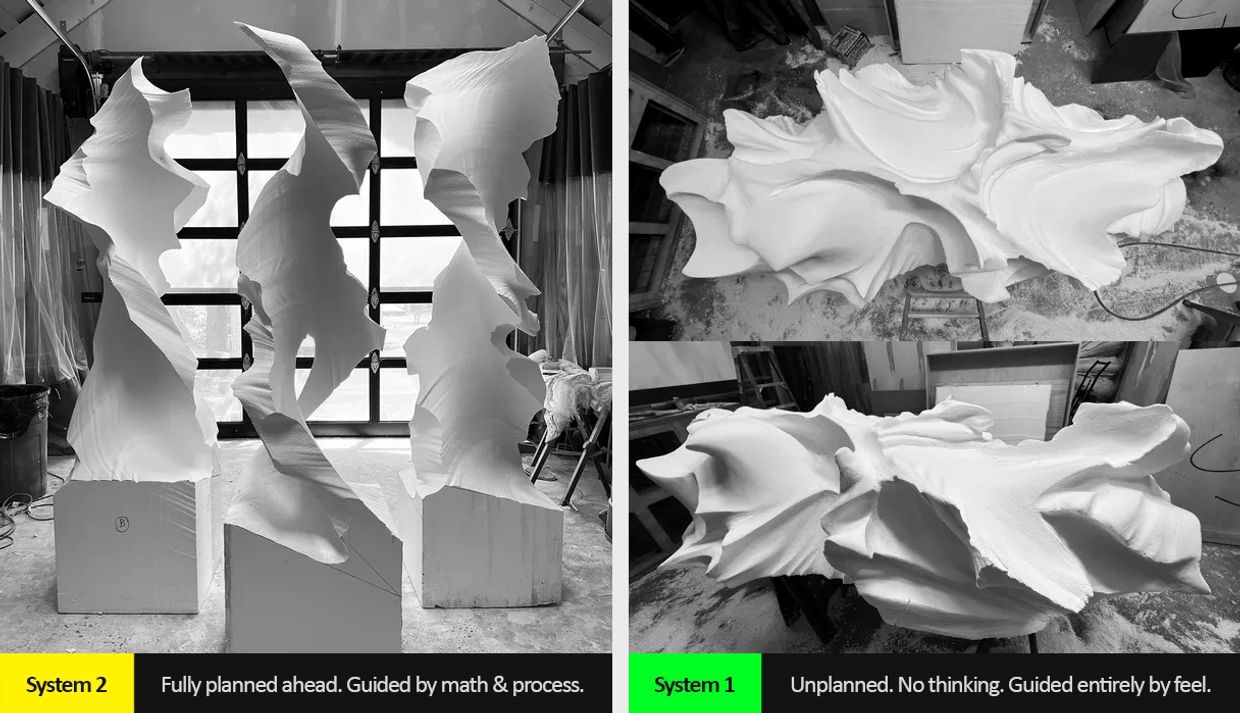
Art by David Kujda, illustrating how System 1 and System 2 each produced uniquely different results
The two systems are very different in their approach to art-making, yet both produce work that, I dare say, I am satisfied with. System 1 pieces often surprise me with outcomes I could not have planned. System 2 pieces leave me satisfied that what I imagined and planned actually holds up. When I try to define my style of working, sometimes these systems can feel conflicting, prompting self-reflection and asking which is better. Kahneman’s explanation helped me see my mind in a new light, as two modes working symbiotically rather than in conflict. Through my own experience, I’ve learned that when one mode takes the lead, it can create a kind of superposition, bringing with it a heightened sense of focus, purpose, and guidance.
This psychology provided the language of System 1 and System 2, and neuroscience suggests that both are active in the brain. It is not either/or. It is both. But, through my own work, I’ve found that the system I lean into at the beginning of a project matters most to me, because it sets the priorities and provides what I need to move forward in a constructive and inspired way.
And if you can relate to the inner debates or the outside forces of institutions, culture, or workplaces that push one mode of thinking over another, consider this: those systems may appear to get more out of people, but they often get less. Maybe the work ahead is not to force ourselves into a single system of thought, but to breathe and notice which part of the mind is gently speaking to us. By allowing that, we give ourselves the agency to move freely between them. And maybe, just maybe, this is where we begin to find our full potential.